
AI Consultant & Systems Orchestrator, Exit 96 Productions
By Clif Dunn · AI Strategy & Change Management · ~9 min read
The fastest way to make a team nervous about AI is to walk into a meeting and say,
"Good news — we're rolling out AI."
To a certain kind of leader, that sentence sounds energetic and forward-thinking.
To a good portion of the people in the room, it sounds like the beginning of a very short horror movie.
"My job is about to change."
"My job is about to disappear."
"I'm going to have to learn this on my own time."
"Great. Another tool I'll be expected to use badly by Friday."
And then there are the people who smile, nod and make a mental note to Google "what is generative AI?" as soon as the meeting ends.
This is where a lot of AI rollouts go wrong.
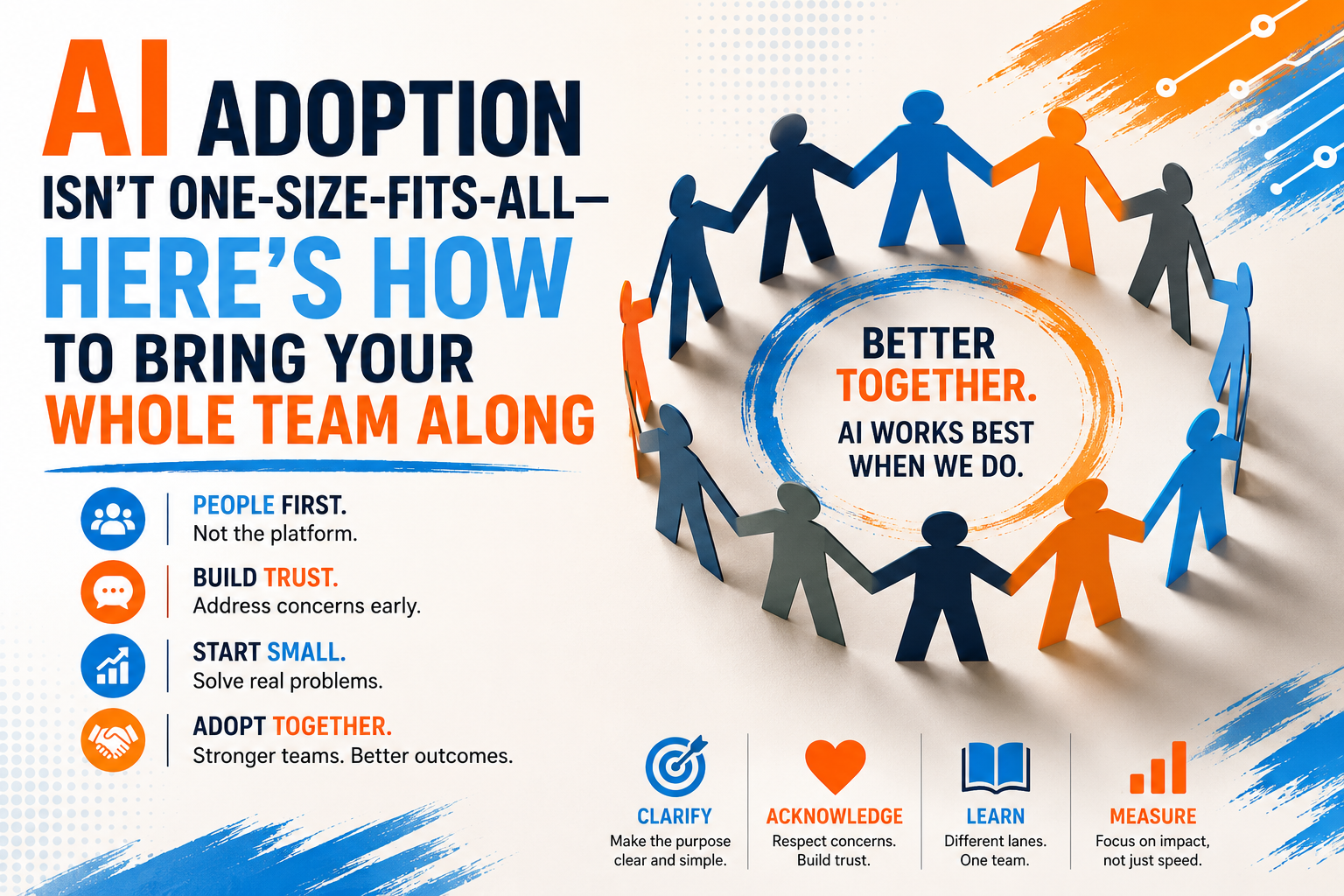
Leaders treat AI adoption like a software implementation when it is really a change management exercise.
Yes, the tool matters.
Yes, the use case matters.
Yes, the policy matters.
But before any of that sticks, people have to believe they are being brought along — not quietly sorted into winners and losers.
A 2024 Boston Consulting Group study found that roughly 70% of AI implementation challenges are people- and process-related, not technical.
A separate Workplace Intelligence survey found that 31% of employees admit to actively undermining their company's AI strategy.
Among Gen Z workers, that number rises to 41%.
The lesson is simple:
Your adoption problem is almost always a trust problem in disguise.
One of the laziest mistakes we make is assuming AI readiness is generational.
It is tempting to think the younger person in the hoodie is automatically the AI whisperer, while the older person in the blazer needs to be gently escorted into the future with a printed instruction sheet.
That is nonsense.
The hoodie may know every TikTok trend and still have no idea how to build a reliable workflow.
The blazer may have 30 years of judgment, pattern recognition and customer insight that makes them an outstanding AI user — once someone gives them a practical on-ramp.
Meanwhile, the person in the middle may already be using AI every day and saying nothing, because they're not sure whether it's allowed.
AI readiness is not about age.
It is about exposure, confidence, context and, above all, trust.
When leaders introduce AI with vague language about "efficiency," people fill in the blanks with their worst fears.
And honestly, can you blame them?
In corporate speak, efficiency has done a lot of suspicious work over the years.
It can mean better systems.
It can also mean three people doing the work of seven while an executive celebrates "operational discipline" on a slide deck.
So if the purpose of AI is to help the team, say that clearly.
If the purpose is to reduce repetitive work, say that.
If the goal is to improve response quality, speed up training, organize knowledge or make customer interactions more consistent — say that.
People can handle the truth much better than they can handle fog.
The most important questions are usually the ones no one wants to ask out loud:
A thoughtful leader doesn't wait for these questions to leak out through sarcasm, resistance or mysterious "system issues."
A thoughtful leader names them early.
That doesn't mean promising things you can't promise.
It means respecting the fact that people are not irrational for having concerns.
AI is powerful, imperfect and moving quickly.
It can produce impressive work.
It can also produce confident nonsense while looking very pleased with itself.
A team deserves to know how the organization plans to use it, where the guardrails are and how human judgment will remain part of the process.
The framing should be simple: AI is here to support people, not embarrass them.
Every team has work nobody loves.
The recurring admin task.
The first draft that takes forever.
The meeting notes nobody wants to clean up.
The internal knowledge base that somehow contains both too much information and not enough.
The customer response that should be simple but requires checking six different places before anyone feels safe answering.
That is exactly where AI should earn trust first.
Not with a grand speech about transformation.
Not with a 47-slide deck featuring a robot shaking hands with a human.
Please, for the sake of everyone, retire that image.
AI earns trust when it helps someone get through Tuesday with less friction.
It can:
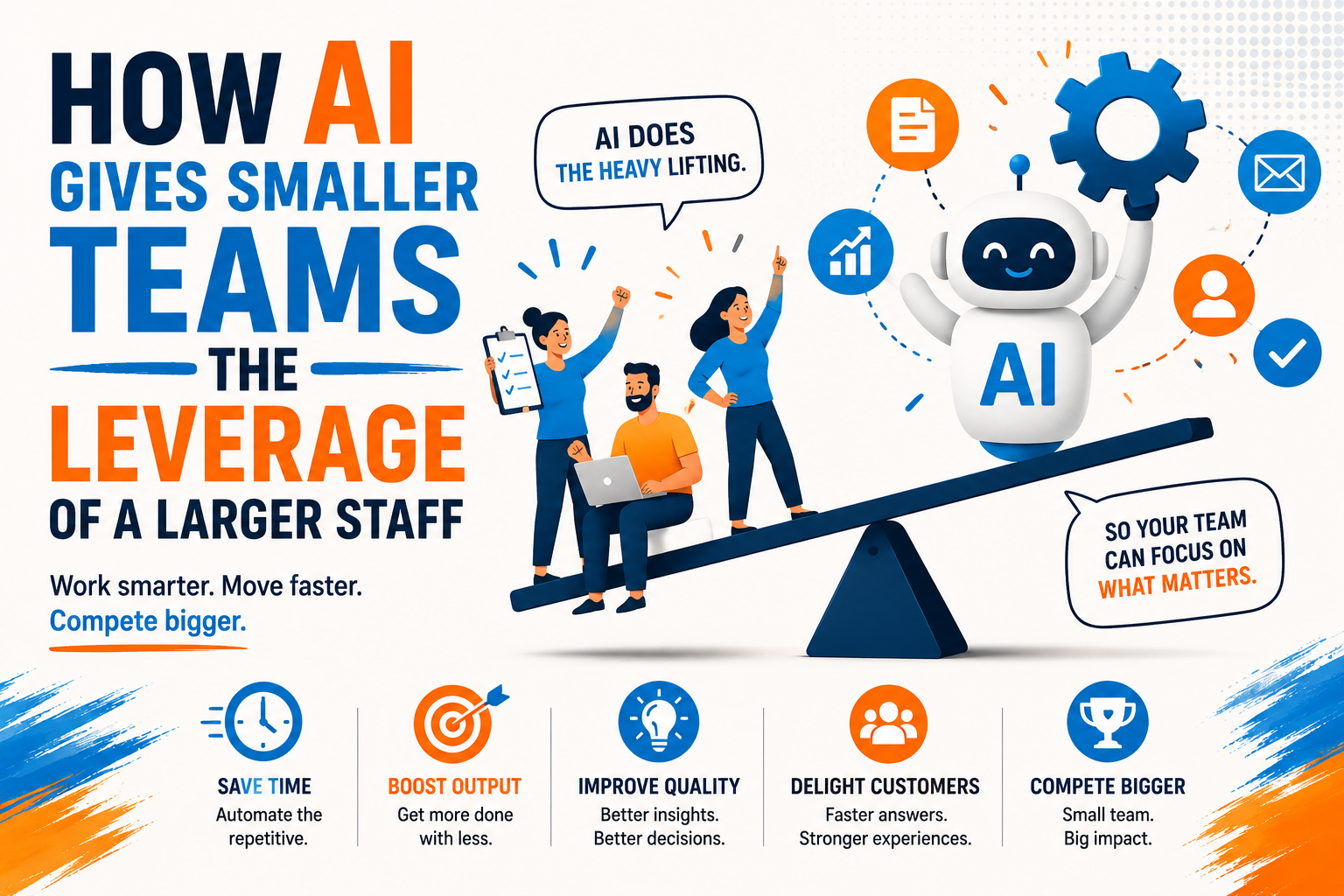
That doesn't make the human less valuable.
In many cases, it makes the human more valuable because it frees them to use judgment, taste and experience instead of burning energy on repetitive setup work.
The key: introduce AI through real problems people already recognize.
A leader might say:
"We're going to test AI on one thing first — cleaning up call notes so agents can spend less time formatting and more time helping customers."
That is much better than:
"We are entering a new era of AI-enabled productivity."
The first sentence gives people a handle.
The second sounds like something a consultant says before invoices appear.
To bring the whole team along, leaders need a calmer rollout model.
Here is a framework I use with clients — and use myself.
C.A.L.M. stands for:
Plain English, always.
Explain why AI is being introduced.
What problem are we solving?
Who benefits?
What will change — and what won't?
If your team can't repeat the reason back in one sentence, the reason isn't clear enough.
Say the quiet part out loud.
"Some of you may be excited. Some skeptical. Some of you may wonder if this is about replacing people. Those are fair reactions."
That kind of honesty lowers the temperature and tells people they don't have to perform enthusiasm before they understand what's happening.
Not everyone learns at the same pace.
Beginners need:
Practitioners need daily use cases.
Power users help discover better workflows.
Those lanes should never become status labels.
The beginner lane is simply where some people start.
Speed is not the only metric.
Faster nonsense is still nonsense.
Ask whether AI is improving:
Also ask:
That last question matters more than most leaders realize.
A forced AI rollout creates compliance without adoption.
People will paste things into the tool, produce the required output and quietly maintain their old process on the side because they don't trust the new one.
Then leadership wonders why the transformation didn't transform much of anything.
The answer is usually simple:
The tool was introduced, but the people were not included.
Skeptics can be annoying.
They can also save you from bad assumptions.
The person asking, "What happens if the AI is wrong?" is not blocking progress.
They may be identifying the guardrail you forgot to build.
Enthusiasm is useful.
Condescension is not.
The goal is to create guides, not gurus.
People need examples.
They need practice.
They need permission.
They need clear boundaries.
They need to see what good use looks like — and mistakes handled without drama.
It is not.
Treating AI like magic sets everyone up for disappointment.
Treating it like a powerful assistant that needs human review is far more useful — and far more honest.
Managers play a special role in all of this.
They don't need to be AI experts.
They do need to model curiosity.
A manager who says,
"I'm learning this too, and we're going to figure out where it actually helps."
creates a very different atmosphere than one who says,
"Corporate wants us using this, so please make sure you do."
Team leads should identify pain points from the ground up.
Ask questions like:
Those are the places to test AI first.
Start small.
Pick one low-risk use case.
Choose a team that understands the problem.
Give them:
Then share the results honestly.
If AI saves time, explain how.
If it creates confusion, fix it.
If people discover a better use case than leadership imagined, celebrate it.
That isn't a failure of planning.
It's the organization learning.
The best AI adoption is not top-down or bottom-up.
It's both.
Leadership provides direction and guardrails.
The team provides reality.
And reality is where the real value lives.
AI will not fix unclear leadership.
It will not repair a low-trust culture.
It will not make people feel valued if every message around it suggests they are costs to be optimized.
In fact, AI may amplify whatever already exists.
If your culture is curious and honest, AI can accelerate learning.
If your culture is fearful and vague, AI can become one more reason people keep their heads down.
That is why bringing AI to a team is ultimately a trust exercise.
The goal is not to drag everyone into the future at the same speed.
The goal is to give everyone a fair way in.
Some people will enter through curiosity.
Some through usefulness.
Some through cautious experimentation.
Some only after they see a colleague they trust use AI successfully.
That's perfectly okay.
A healthy rollout does not require everyone to become an AI evangelist by Friday.
It requires leaders to remember that behind every new tool is a human being deciding whether to lean in, hold back or quietly panic.
Bring the whole team along — blazers, hoodies and everyone in between.
The technology will keep changing. The need for trust will not.
Clif Dunn helps organizations build AI adoption strategies that actually work by starting with the people, not the platform.
→ Schedule a conversation at ClifDunn.com
[1] Ball, V.E., Schimmelpfennig, D., & Wang, S.L. (2022). The Drivers of U.S. Agricultural Productivity Growth. Federal Reserve Bank of Kansas City. Consumer-to-farmer ratio data: 13:1 in 1900, 159:1 in 2017.
[2] U.S. Bureau of Labor Statistics. Nonfarm Business Sector: Real Output Per Hour of All Persons (OPHNFB). Federal Reserve Bank of St. Louis (FRED). fred.stlouisfed.org/series/OPHNFB
[3] Dell’Acqua, F., McFowland, E., Mollick, E.R., et al. (2023). Navigating the Jagged Technological Frontier: Field Experimental Evidence of the Effects of AI on Knowledge Worker Productivity and Quality. Harvard Business School Working Paper 24-013.
[4] Brynjolfsson, E., Li, D., & Raymond, L.R. (2023). Generative AI at Work. NBER Working Paper 31161. nber.org/papers/w31161
[5] GitHub Research. (2023). Research: Quantifying GitHub Copilot’s Impact on Developer Productivity and Happiness. github.blog
[6] Hao, Q., Xu, F., Li, Y., & Evans, J. (2026). Artificial intelligence tools expand scientists’ impact but contract science’s focus. Nature, 649, 1237–1243. nature.com/articles/s41586-025-09922-y

I'm doing my part to ensure AI has a positive impact on your life and your business.


.png)

