
AI Consultant & Systems Orchestrator, Exit 96 Productions
By Clif Dunn · AI Strategy & Small Business Operations · ~7 min read
Imagine this scenario.
A solo consultant starts using AI to clean up the parts of her business she hates most:
No robot butler.
No holographic assistant named "Dex."
Just the usual pile of small business admin that multiplies like rabbits in a filing cabinet.
Within a month she estimates AI has saved her about twelve hours.
At her billing rate, that is not theoretical productivity.
That is money.
Then AI makes a mistake.
In one proposal, it pulls language from an earlier client document and inserts the wrong deadline.
The rest of the proposal looks polished.
Confident.
Professional.
The kind of document that says, "I went to business school and own matching luggage."
The client catches the error.
No disaster follows.
But the consultant has to apologize, recheck the document and rethink her workflow.
AI has saved time and money.
It has also created a mistake she nearly missed.
That is the whole conversation in miniature.
Artificial intelligence for small business is not good or bad.
It is leverage.
And leverage makes everything bigger, including the stuff you should have checked twice.
For small business owners, solopreneurs and lean teams, the real question is not:
"Should I use AI?"
The better question is:
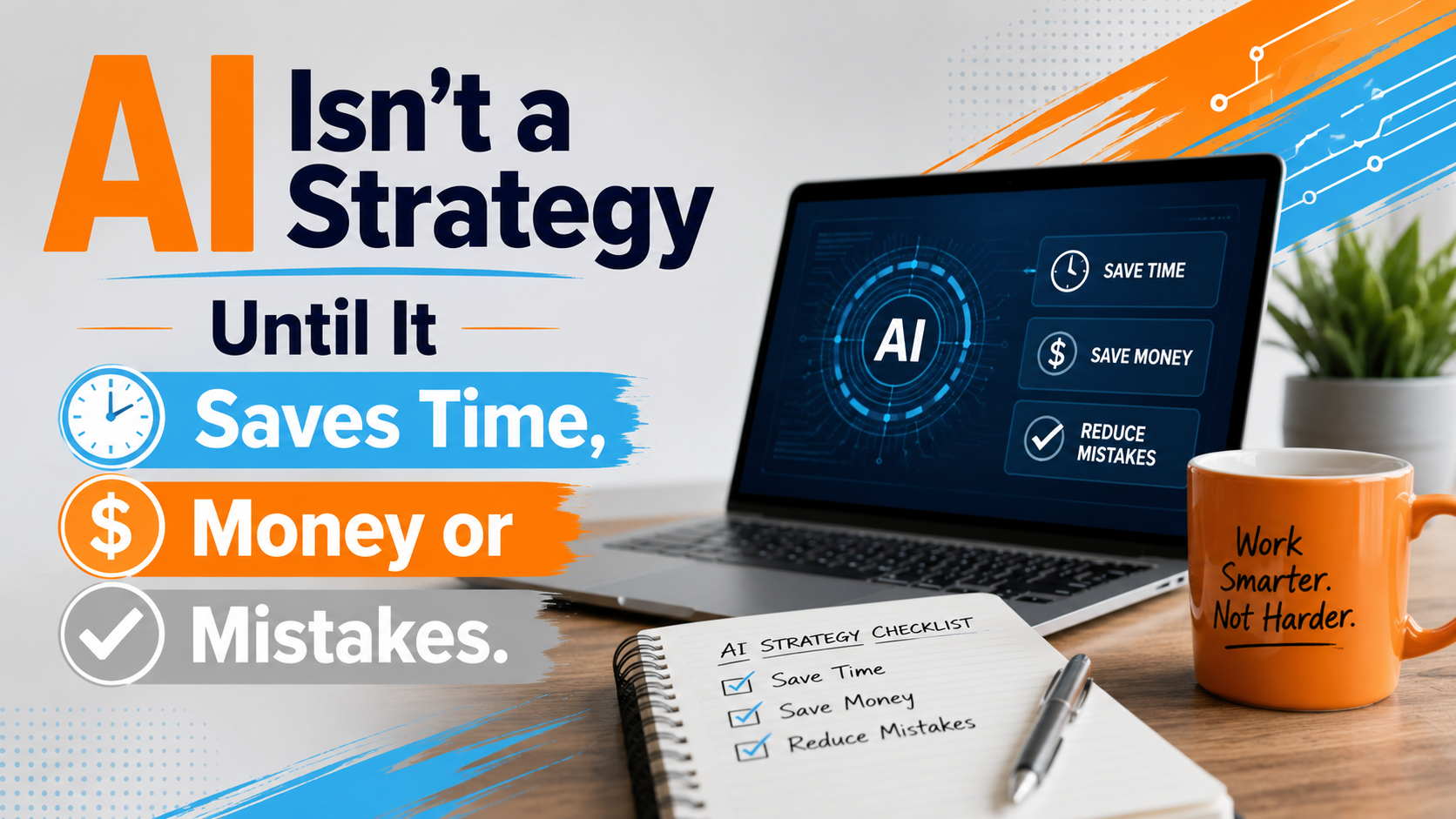
"Where does AI save time, save money or reduce mistakes?"
Because until it does one of those three things, AI is not a strategy.
It is software tourism.
The most immediate advantage of AI for solopreneurs is speed.
Not magic speed.
Practical speed.
AI is excellent at taking the first pass on work that usually begins with a human staring at a blinking cursor, questioning every life decision since 1997.
It can:
That matters because most small business productivity problems are not really about laziness.
They are about context switching.
A solopreneur might go from sales call to invoice to client work to marketing to tech support to "why is the printer making that noise?" in a single morning.
AI helps by reducing the mental drag between tasks.
It gives you a starting point.
And starting points are underrated.
But AI can also waste time with impressive efficiency.
You can spend 45 minutes prompting a tool to write the perfect three-sentence email you could have written yourself in 12 minutes.
You can generate 30 content ideas then lose an afternoon deciding which ones are mediocre in the most promising way.
Congratulations. You have automated procrastination.
The key to AI workflow automation is not using AI everywhere.
It is using AI where the cost of a rough first draft is low and the value of momentum is high.
Use it to start.
Use it to organize.
Use it to summarize.
But do not confuse output with completion.
AI can get you to the 60-yard line quickly.
You still have to know which direction the end zone is.
Use AI where the cost of a rough first draft is low and the value of momentum is high.
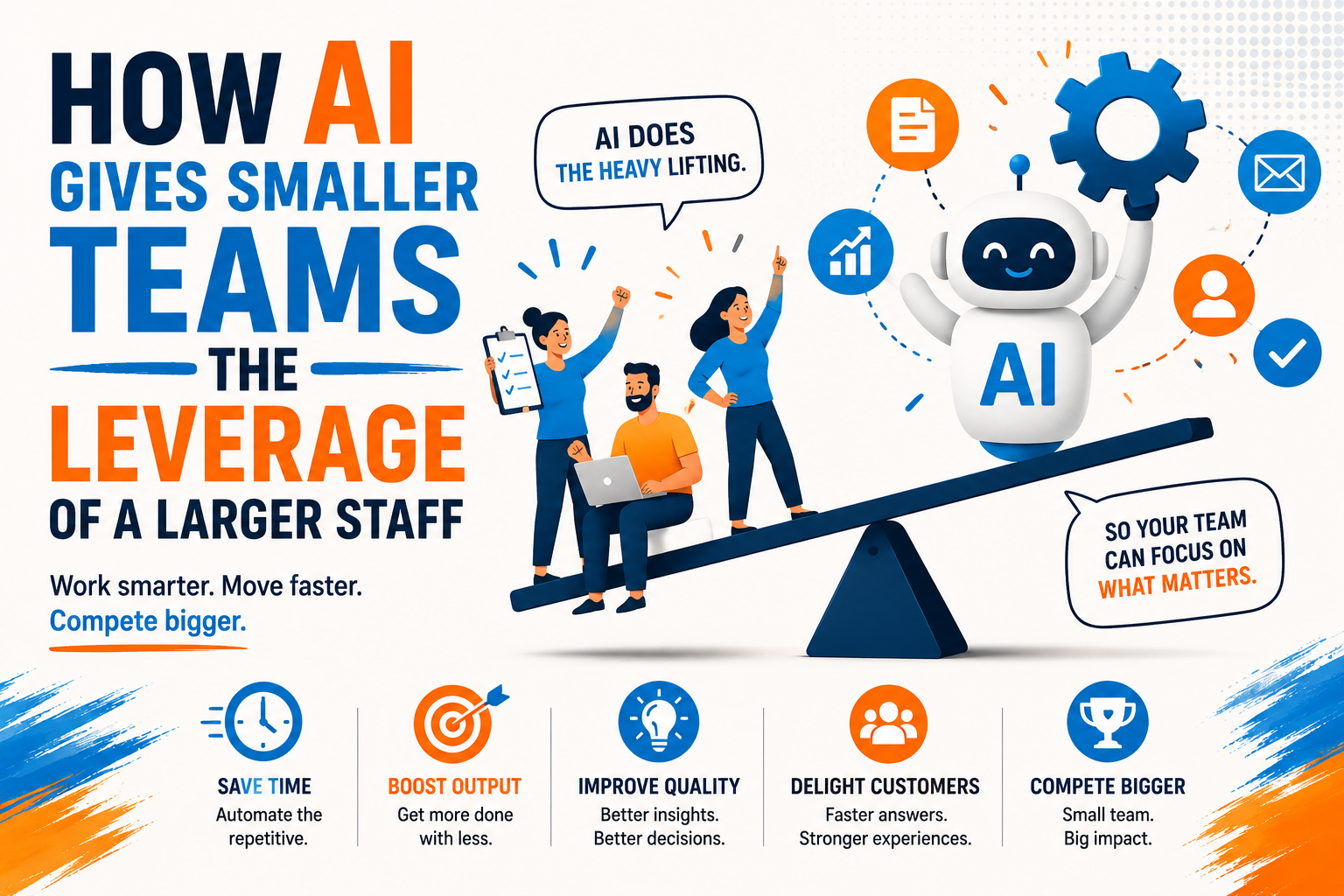
For many small businesses, AI can act like a fractional assistant, analyst, copywriter, trainer or operations coordinator.
Not a replacement for those people.
But AI can create capacity before you are ready to hire.
That is where AI cost savings become real.
A business owner can use AI to:
For a lean company, that is meaningful.
AI reduces the amount of paid time spent on repetitive work.
It helps a small team look more organized than it feels.
But AI tools for business can also create new expenses.
The first danger is subscription sprawl.
A $20 tool here.
A $49 tool there.
A $99 "must-have" platform somewhere else.
Suddenly your cost-saving AI stack has become a raccoon with a corporate card.
The second danger is bad automation at scale.
A flawed email, wrong offer or poorly reviewed ad can reach hundreds of people very quickly.
AI does not just help you move faster.
It can help you embarrass yourself faster, which is a service nobody requested.
The third danger is generic content.
A business can save money producing more marketing with AI.
But if that marketing sounds like every other business using the same prompts, the savings are fake.
Bland content does not build trust.
It fills space.
Before buying another tool, ask three questions:
When the answer is "it seems cool," close the tab and go drink water.
The most underrated use of AI in business operations may be mistake prevention.
AI is useful as a reviewer because it does not get bored, hungry or personally offended by your third revision.
You can ask it to:
That last one is especially valuable.
Small businesses tend to move fast because they have to.
But speed creates blind spots.
AI can help surface the obvious thing nobody noticed because everyone was busy being heroic.
In customer service, AI can review support responses for tone and completeness.
In marketing, it can check whether campaign assets match the offer.
In operations, it can turn tribal knowledge into repeatable processes.
Used well, AI risk management is not about replacing human judgment.
It is about giving human judgment more to work with.
But AI also creates mistakes because it is very good at sounding right.
That is the spooky part.
AI can hallucinate facts, invent citations, misread context or produce confident nonsense in a tailored blazer.
It can mix up names, dates, prices, policies and product features.
It can also flatten nuance, which matters a great deal when you are communicating with customers or clients.
For small business AI strategy, the danger is not just that AI makes mistakes.
The danger is that the mistakes look finished.
A sloppy human draft often announces itself.
An AI draft may arrive polished enough to sneak past your common sense.
That is how wrong information gets into proposals, web pages and client reports.
There are also privacy and compliance risks.
Business owners should be careful about pasting customer data, employee information or confidential strategy into AI tools without understanding how that information may be stored or used.
And then there is accountability.
Customers will not care that the AI did it.
Regulators will not care.
Your spouse definitely will not care, though they may admire your creativity.
The business owner owns the outcome.
AI can draft, review, suggest and identify patterns.
But humans still need to verify facts, promises, prices, legal language and anything that could get the business into a very uncomfortable Zoom call.
The danger is not just that AI makes mistakes. The danger is that the mistakes look finished.
The businesses that win with artificial intelligence for small business will not be the ones with the most tools.
They will be the ones with the clearest judgment.
AI becomes strategic only when it reliably improves one of three things:
Does it reduce hours spent on low-value work?
Does it lower costs, increase useful output or support better revenue?
Does it catch errors, reduce risk or improve consistency?
If the answer is yes, you may have something worth building into your workflow.
If the answer is no, you may just have:
The smartest approach is not to AI everything.
Choose one process.
Define the outcome.
Test the tool.
Measure the result.
Ask yourself:
That is the difference between using AI and merely admiring it.
For small business owners and solopreneurs, AI can be a real advantage.
It can create capacity.
Sharpen thinking.
Reduce preventable errors.
But it still needs supervision, process and a human being willing to read the thing before hitting Send.
That may not sound futuristic.
But it does sound profitable.
Clif Dunn helps small business owners and solopreneurs identify where AI actually saves time, money and mistakes — and where it doesn't.
→ Schedule a conversation at ClifDunn.com
[1] Ball, V.E., Schimmelpfennig, D., & Wang, S.L. (2022). The Drivers of U.S. Agricultural Productivity Growth. Federal Reserve Bank of Kansas City. Consumer-to-farmer ratio data: 13:1 in 1900, 159:1 in 2017.
[2] U.S. Bureau of Labor Statistics. Nonfarm Business Sector: Real Output Per Hour of All Persons (OPHNFB). Federal Reserve Bank of St. Louis (FRED). fred.stlouisfed.org/series/OPHNFB
[3] Dell’Acqua, F., McFowland, E., Mollick, E.R., et al. (2023). Navigating the Jagged Technological Frontier: Field Experimental Evidence of the Effects of AI on Knowledge Worker Productivity and Quality. Harvard Business School Working Paper 24-013.
[4] Brynjolfsson, E., Li, D., & Raymond, L.R. (2023). Generative AI at Work. NBER Working Paper 31161. nber.org/papers/w31161
[5] GitHub Research. (2023). Research: Quantifying GitHub Copilot’s Impact on Developer Productivity and Happiness. github.blog
[6] Hao, Q., Xu, F., Li, Y., & Evans, J. (2026). Artificial intelligence tools expand scientists’ impact but contract science’s focus. Nature, 649, 1237–1243. nature.com/articles/s41586-025-09922-y
I'm doing my part to ensure AI has a positive impact on your life and your business.

.png)

